Pyrolysis Plant for End-of-Life Tyres: Technology, Products, and Resource Recovery
End-of-life tyres present a formidable municipal and industrial waste challenge due to their cross-linked vulcanized rubber matrices and resistance to natural biodegradation. Stockpiling these elastomeric wastes creates persistent fire hazards and vector-breeding habitats. Conventional disposal methods like landfilling or direct incineration fail to capture the high-value hydrocarbons embedded within synthetic and natural rubber compounds. Implementing an industrial pyrolysis plant for end-of-life tyres provides a thermochemical conversion pathway that depolymerizes scrap rubber into valuable chemical fractions, liquid fuels, and solid carbonaceous residues.
Thermochemical Mechanisms of Tyre Rubber Depolymerization
Tyre rubber is a complex composite consisting of polyisoprene, polybutadiene, styrene-butadiene rubber, carbon black, steel cord, and inorganic additives. Converting this complex matrix requires precise thermal cracking within an oxygen-deprived environment. A specialized waste tire pyrolysis equipment operates by breaking the strong covalent carbon-carbon and carbon-sulfur bonds that constitute the vulcanized rubber lattice.
When scrap tyres are heated to temperatures between 400°C and 600°C, the organic polymer chains undergo scission without combustion. Thermal degradation initiates with the cleavage of weak polysulfidic cross-links before progressing to the random scission of the main hydrocarbon backbone. This devolatilization phase generates a complex mixture of condensable hydrocarbon vapors, non-condensable permanent gases, and a non-volatile solid fraction consisting of carbon black and inorganic fillers.
Core Operational Stages of Industrial Pyrolysis Systems
The transformation of whole or shredded tires into refined outputs relies on a series of integrated mechanical and thermal operations designed for safety and material stability:
- Feedstock Pre-Treatment: Whole tyres undergo mechanical de-beading to extract high-tensile steel wire bundles prior to shredding. The remaining rubber is processed into uniform shreds to optimize thermal conductivity and ensure steady movement through the reactor feed system.
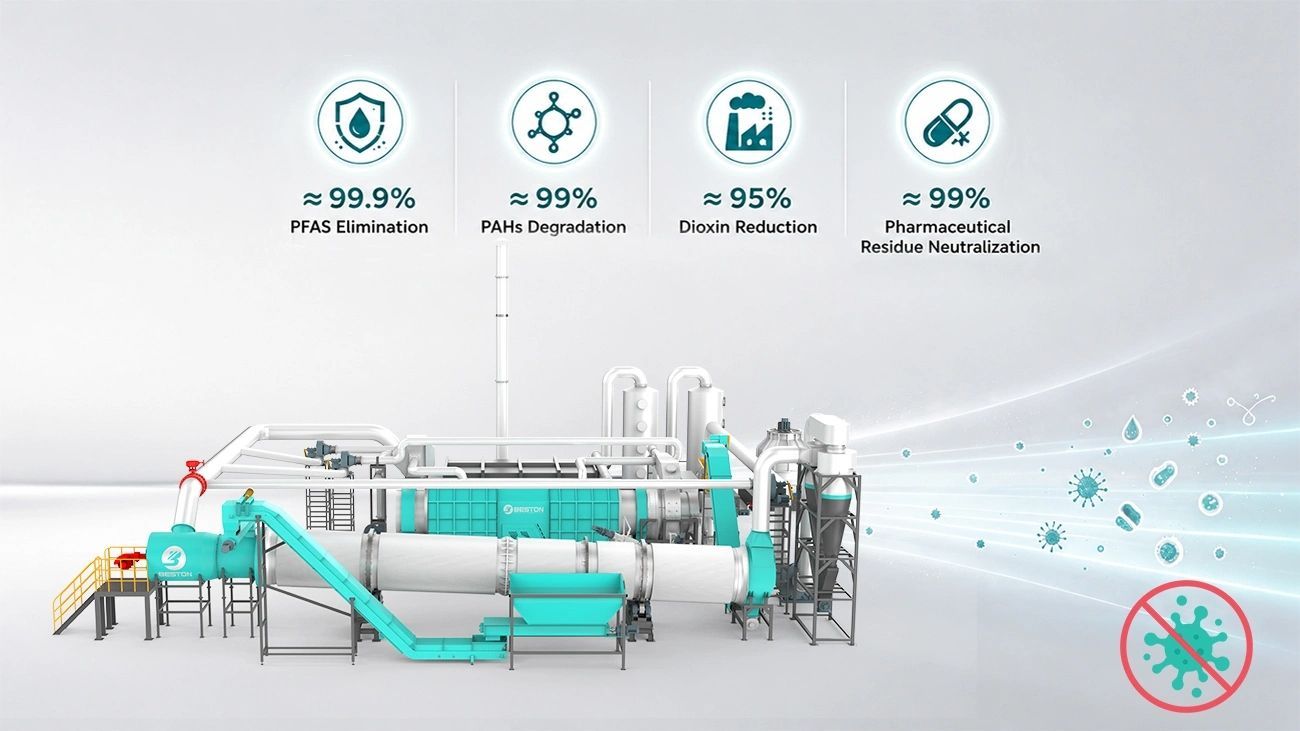
- Anoxic Pyrolysis Reactor: The prepared rubber granules are fed into a sealed continuous rotary kiln. Maintaining strict hermetic sealing prevents oxygen ingress, eliminating combustion risks while ensuring the purity of the synthetic vapors generated during thermal cracking.
- Vapor Condensation and Fractionation: Heavy vapor fractions exit the reactor chamber and enter a multi-stage condensing system. Rapid cooling fractionates condensable hydrocarbons into liquid pyrolytic oil while separating non-condensable light gases for thermal energy recovery.
- Char Cooling and Magnetic Separation: The hot solid carbon residue exits through a water-jacketed cooling screw to drop the material below auto-ignition temperatures. Inline high-intensity magnetic separators recover fine steel wires before the char undergoes micro-milling.
Recovery Profiles and Commercial Output Properties
Thermochemical depolymerization yields four distinct, high-value resource streams that integrate directly into industrial manufacturing and energy supply chains:
Pyrolytic Oil (Heavy Hydrocarbon Liquid)
The primary liquid product is a dark, complex mixture of aromatic, aliphatic, and naphthenic hydrocarbons with a high gross calorific value exceeding 40 MJ/kg. Pyrolytic oil serves as a direct substitute for heavy fuel oil in industrial boilers, furnaces, and power generation systems. Advanced hydro-treating and fractional distillation can further upgrade this liquid into commercial-grade diesel substitutes or chemical feedstocks such as limonene and toluene.
Recovered Carbon Black (rCB)
The solid char residue remaining after devolatilization contains recovered carbon black alongside zinc sulfide and inorganic fillers. Raw pyrolytic char undergoes pulverization, de-ashing, and pelletization to produce commercial-grade rCB. This material replaces virgin carbon black derived from fossil fuels in semi-reinforcing rubber compounds, masterbatches, coatings, and printing inks, drastically reducing industrial carbon footprints.
Non-Condensable Syngas Loop
The non-condensable gas fraction consists predominantly of methane, ethane, propane, hydrogen, and hydrogen sulfide. Instead of venting or flaring these gases, the plant routes them through gas scrubbing units to remove sulfur compounds before directing the purified syngas back into the furnace burners. This closed-loop thermal integration makes the continuous operational cycle self-sustaining, minimizing reliance on external fuel sources.
High-Tensile Steel Wire Recovery
Steel wire extracted during pre-treatment and post-pyrolysis magnetic separation retains high tensile strength and structural integrity. Recovered steel is directed to scrap metal recyclers and electric arc furnace steelmakers for remelting, establishing a complete circular economy for tyre reinforcement materials.
By integrating continuous thermochemical processing, modern processing units divert millions of scrap tyres from landfills while yielding essential raw materials for energy and manufacturing sectors.