Mobile Biochar Machine: How On-Site Carbonization Can Reduce Biomass Transportation Costs
Biomass waste is often generated far away from centralized processing facilities. Agricultural residues, forestry waste, orchard prunings, and other organic materials may need to be collected and transported before they can be converted into useful products. For businesses handling large quantities of low-density biomass, transportation can become a significant part of the overall operating cost.
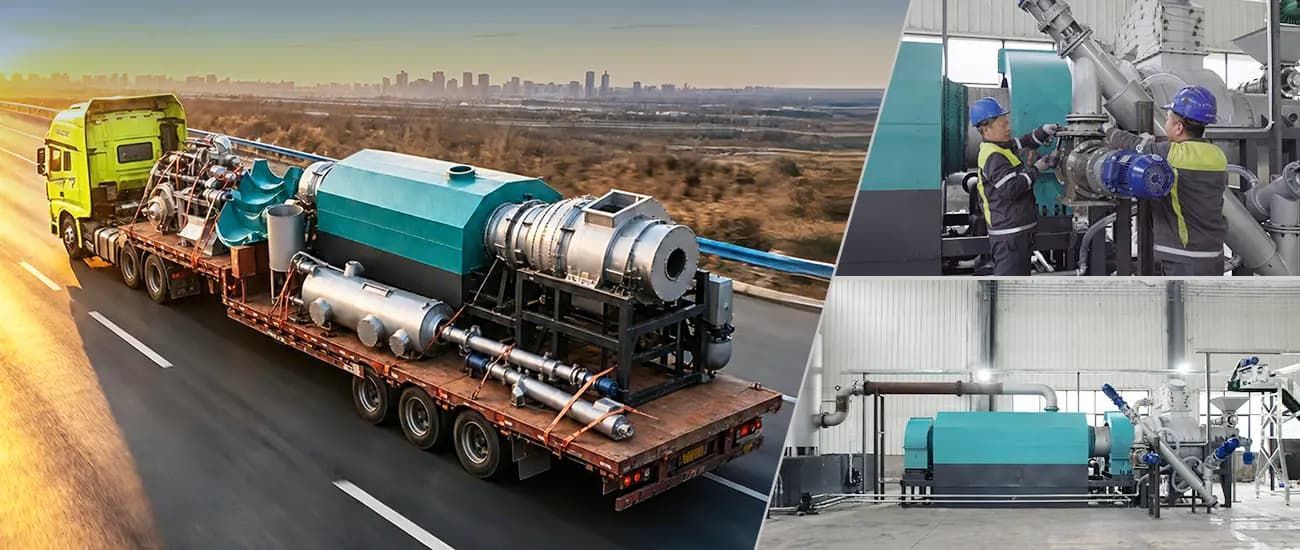
A mobile biochar machine offers a different approach: instead of transporting all the raw biomass to a fixed processing plant, the carbonization equipment can be moved closer to where the biomass is generated. By processing biomass on-site, businesses can reduce unnecessary transportation and convert bulky organic waste into a more compact, valuable carbon-rich product.
Why Biomass Transportation Can Be Expensive
Many types of biomass have a relatively low bulk density. Straw, branches, leaves, sawdust, and other agricultural residues can occupy considerable space compared with their actual dry weight.
This creates a transportation challenge. Trucks may reach their volume limit before reaching their maximum weight capacity. At the same time, biomass with high moisture content can add substantial weight without increasing its energy or carbon value.
Transportation costs therefore depend not only on the amount of biomass available but also on its moisture content, bulk density, transportation distance, loading efficiency, and local fuel prices.
When biomass is generated across multiple farms or remote sites, repeatedly transporting it to a centralized facility can make waste processing less economical.
How On-Site Carbonization Changes the Logistics Model
A mobile biochar machine changes the traditional biomass logistics chain.
Instead of following the model of:
Biomass collection → Long-distance transportation → Fixed plant → Carbonization → Biochar distribution
A mobile biochar machine can support:
Biomass collection → On-site carbonization → Biochar transportation
This means that part of the biomass handling process occurs close to the source. After carbonization, the resulting biochar is generally more concentrated than the original loose biomass, making subsequent transportation and storage easier to manage.
The actual reduction in transportation cost depends on feedstock characteristics, processing conditions, distance, and local logistics. However, the fundamental advantage is straightforward: businesses can avoid transporting material that does not need to travel long distances in its original bulky form.
Suitable Applications for Mobile Biochar Machines
Mobile biochar equipment is particularly attractive when biomass is geographically dispersed.
For example, agricultural producers may generate large amounts of crop residues after harvesting. Forestry operations can produce branches, bark, and other wood residues across different sites. Orchards generate pruning waste seasonally, often in locations that are not close to industrial processing facilities.
In these situations, moving a mobile biochar machine between biomass collection areas can provide greater flexibility than building a fixed facility at every location.
The approach can also be useful for biomass contractors and waste management companies that serve multiple customers. Instead of relying on a single permanent processing site, operators can bring carbonization capacity closer to different biomass sources.
Lower Transportation Volume, Higher Resource Value
The transportation advantage is only one part of the equation. On-site carbonization can also change the value of the biomass.
Raw agricultural waste may have limited commercial value because of its high moisture content, low bulk density, or limited local demand. After controlled carbonization, it becomes biochar, a stable carbon-rich material that can be used in soil management, composting, growing media, and other applications depending on its properties.
This creates a potential transition from a waste-disposal cost to a resource-recovery model.
Instead of asking, “How much will it cost to transport this waste?” businesses can begin asking, “Can we process this waste where it is generated and sell or use the resulting biochar?”
Important Factors When Choosing Mobile Equipment
Not every biomass operation requires the same mobile biochar machine. Several factors should be evaluated before investment.
First, the equipment should match the actual feedstock. Moisture content, particle size, density, and composition can significantly affect carbonization performance.
Second, mobility should be considered together with production capacity. A machine that is easy to relocate but has insufficient throughput may not meet the needs of a commercial operation.
Third, energy efficiency is important. A well-designed system can recover combustible gases generated during carbonization and use them as a supplementary heat source, reducing external fuel consumption.
Finally, automation, temperature control, sealing, cooling, and emissions management should be considered as part of the complete system rather than as optional features.
Is Mobile Biochar Production Right for Your Business?
A mobile biochar machine is most attractive when biomass is abundant but geographically dispersed, transportation distances are significant, and building multiple fixed processing facilities is impractical.
It may not completely eliminate transportation costs, because biomass still needs to be collected and the finished biochar may need to reach its final destination. However, changing **what is transported, where it is processed, and when it is moved** can significantly improve the overall logistics model.
For agricultural businesses, forestry operators, biomass contractors, and decentralized waste management projects, on-site carbonization provides a practical way to bring processing capacity closer to the feedstock.
Ultimately, the value of a mobile biochar machine is not simply its ability to move from one location to another. Its real advantage is the possibility of processing biomass where it is generated, reducing the burden of transporting bulky raw materials while creating a more valuable and stable biochar product.