Key Safety Standards and Risk Prevention Measures in Tyre to Oil Plant Operation
Cathy Wang • September 15, 2026

Operating a tyre pyrolysis facility involves high temperatures, combustible gases, flammable liquids, rotating machinery, and pressurized process equipment. A well-engineered tyre to oil plant therefore requires safety controls that address the entire process chain, from tyre preparation and feeding to pyrolysis, gas handling, oil condensation, residue discharge, and storage. Safety should be integrated into equipment design and operating procedures rather than treated as a separate compliance activity.

Process Safety Starts with Hazard Identification

Before commissioning, the major hazards should be identified through a structured process hazard assessment. Typical scenarios include reactor overheating, combustible-gas leakage, abnormal pressure, loss of cooling, feed-system blockage, and ignition of hydrocarbon vapors.

A HAZOP (Hazard and Operability Study) can be used to systematically examine deviations such as excessive temperature, insufficient flow, or unexpected pressure. Emergency scenarios should also be evaluated through risk assessment and operating procedures.

The assessment should consider both normal operation and foreseeable abnormal conditions. Interlocks, alarms, emergency shutdown systems, pressure-relief devices, and temperature monitoring can then be incorporated according to the identified hazards.

Temperature and Pressure Require Continuous Control

Pyrolysis occurs at elevated temperatures, making thermal control one of the fundamental safety requirements. Excessive heating can accelerate unwanted secondary reactions, increase gas generation, and place additional stress on process components.

A modern tyre to oil plant should use multiple temperature-monitoring points rather than relying on a single measurement. Automated control can regulate the heating system and trigger protective actions when predefined limits are exceeded.

Pressure control is equally important. The reactor and connected piping should be designed for the applicable operating conditions, with appropriate pressure-relief and isolation provisions. Sudden pressure changes may indicate condensation problems, blockage, excessive gas production, or abnormal operating conditions and should be investigated immediately.

Combustible Gas Management Prevents Ignition Hazards

Pyrolysis generates non-condensable gases containing combustible hydrocarbons. These gases can be recovered as process fuel, but uncontrolled accumulation presents a significant fire and explosion hazard.

Gas piping should be properly sealed and routinely inspected for leakage. Pressure, flow, and temperature should be monitored at critical locations. Where applicable, gas detection and ventilation systems can provide additional protection around areas where combustible gases may accumulate.

Ignition sources must also be controlled. Electrical equipment installed in hazardous areas should be appropriately selected for the classified environment, while hot surfaces, sparks, and unauthorized flame sources should be prevented from contacting hydrocarbon vapors.

Feedstock Preparation and Mechanical Safety Matter

Tyres contain steel reinforcement and other materials that can create mechanical hazards during cutting, shredding, and conveying. Guards, emergency-stop devices, interlocks, and safe maintenance procedures are essential around rotating and cutting machinery.

Feedstock specifications should also be controlled. Oversized tyres, excessive foreign material, or unsuitable inputs can cause feeding difficulties and mechanical obstruction. Consistent feed preparation helps reduce both operational instability and equipment stress.

Lockout/tagout procedures should be applied before maintenance or cleaning activities involving electrical, mechanical, thermal, or pneumatic energy.

Fire Protection and Emergency Response

Fire protection should cover the reactor area, gas system, oil-processing section, and product-storage area. Appropriate extinguishing systems, fire detection, emergency shutdown controls, clearly marked escape routes, and accessible emergency equipment are fundamental components of the safety strategy.

Operators should receive documented training for abnormal conditions, including power failure, cooling-system failure, gas leakage, excessive temperature, and emergency shutdown. Regular drills can verify whether procedures are practical rather than merely documented.

Compliance Requires More Than Equipment Certification

Applicable standards vary by country and project configuration. Depending on the jurisdiction, requirements may cover pressure equipment, electrical installations, hazardous-area classification, fire protection, occupational safety, emissions, and environmental permitting.

For a tyre to oil plant, compliance should therefore be verified against the regulations and recognized standards applicable at the installation site. Equipment documentation, inspection records, maintenance schedules, operating procedures, and staff training should form part of the overall safety management system.

Ultimately, safe tyre pyrolysis depends on layered protection: sound mechanical design, reliable instrumentation, controlled operating parameters, effective gas management, preventive maintenance, and trained personnel. No single safety device can compensate for weaknesses elsewhere in the process.
By Cathy Wang September 15, 2026
Biomass waste is often generated far away from centralized processing facilities. Agricultural residues, forestry waste, orchard prunings, and other organic materials may need to be collected and transported before they can be converted into useful products. For businesses handling large quantities of low-density biomass, transportation can become a significant part of the overall operating cost. A mobile biochar machine offers a different approach: instead of transporting all the raw biomass to a fixed processing plant, the carbonization equipment can be moved closer to where the biomass is generated. By processing biomass on-site, businesses can reduce unnecessary transportation and convert bulky organic waste into a more compact, valuable carbon-rich product. Why Biomass Transportation Can Be Expensive Many types of biomass have a relatively low bulk density. Straw, branches, leaves, sawdust, and other agricultural residues can occupy considerable space compared with their actual dry weight. This creates a transportation challenge. Trucks may reach their volume limit before reaching their maximum weight capacity. At the same time, biomass with high moisture content can add substantial weight without increasing its energy or carbon value. Transportation costs therefore depend not only on the amount of biomass available but also on its moisture content, bulk density, transportation distance, loading efficiency, and local fuel prices. When biomass is generated across multiple farms or remote sites, repeatedly transporting it to a centralized facility can make waste processing less economical. How On-Site Carbonization Changes the Logistics Model A mobile biochar machine changes the traditional biomass logistics chain. Instead of following the model of: Biomass collection → Long-distance transportation → Fixed plant → Carbonization → Biochar distribution A mobile biochar machine can support: Biomass collection → On-site carbonization → Biochar transportation This means that part of the biomass handling process occurs close to the source. After carbonization, the resulting biochar is generally more concentrated than the original loose biomass, making subsequent transportation and storage easier to manage. The actual reduction in transportation cost depends on feedstock characteristics, processing conditions, distance, and local logistics. However, the fundamental advantage is straightforward: businesses can avoid transporting material that does not need to travel long distances in its original bulky form. Suitable Applications for Mobile Biochar Machines Mobile biochar equipment is particularly attractive when biomass is geographically dispersed. For example, agricultural producers may generate large amounts of crop residues after harvesting. Forestry operations can produce branches, bark, and other wood residues across different sites. Orchards generate pruning waste seasonally, often in locations that are not close to industrial processing facilities. In these situations, moving a mobile biochar machine between biomass collection areas can provide greater flexibility than building a fixed facility at every location. The approach can also be useful for biomass contractors and waste management companies that serve multiple customers. Instead of relying on a single permanent processing site, operators can bring carbonization capacity closer to different biomass sources. Lower Transportation Volume, Higher Resource Value The transportation advantage is only one part of the equation. On-site carbonization can also change the value of the biomass. Raw agricultural waste may have limited commercial value because of its high moisture content, low bulk density, or limited local demand. After controlled carbonization, it becomes biochar, a stable carbon-rich material that can be used in soil management, composting, growing media, and other applications depending on its properties. This creates a potential transition from a waste-disposal cost to a resource-recovery model. Instead of asking, “How much will it cost to transport this waste?” businesses can begin asking, “Can we process this waste where it is generated and sell or use the resulting biochar?” Important Factors When Choosing Mobile Equipment Not every biomass operation requires the same mobile biochar machine. Several factors should be evaluated before investment. First, the equipment should match the actual feedstock. Moisture content, particle size, density, and composition can significantly affect carbonization performance. Second, mobility should be considered together with production capacity. A machine that is easy to relocate but has insufficient throughput may not meet the needs of a commercial operation. Third, energy efficiency is important. A well-designed system can recover combustible gases generated during carbonization and use them as a supplementary heat source, reducing external fuel consumption. Finally, automation, temperature control, sealing, cooling, and emissions management should be considered as part of the complete system rather than as optional features. Is Mobile Biochar Production Right for Your Business? A mobile biochar machine is most attractive when biomass is abundant but geographically dispersed, transportation distances are significant, and building multiple fixed processing facilities is impractical. It may not completely eliminate transportation costs, because biomass still needs to be collected and the finished biochar may need to reach its final destination. However, changing **what is transported, where it is processed, and when it is moved** can significantly improve the overall logistics model.  For agricultural businesses, forestry operators, biomass contractors, and decentralized waste management projects, on-site carbonization provides a practical way to bring processing capacity closer to the feedstock. Ultimately, the value of a mobile biochar machine is not simply its ability to move from one location to another. Its real advantage is the possibility of processing biomass where it is generated, reducing the burden of transporting bulky raw materials while creating a more valuable and stable biochar product.
By Cathy Wang September 10, 2026
Agricultural residues are often treated as low-value by-products, yet materials such as pruning branches, nut shells, straw, and other woody biomass contain substantial quantities of carbon. A portable biochar kiln provides farmers with a practical way to convert these residues into stable carbon-rich biochar directly near the point of generation. This localized approach reduces unnecessary biomass transport while creating a material that can be returned to soil or used in other agricultural applications. Bringing Carbon Conversion Closer to the Farm Conventional biomass processing can require centralized facilities, dedicated transportation, and substantial material handling. For farms with dispersed fields or seasonal residues, these requirements may undermine the economic feasibility of carbon management. A portable biochar kiln changes this logistical equation. Its mobility allows the equipment to be positioned close to orchards, plantations, forestry plots, or crop-production areas where biomass accumulates. Instead of hauling bulky, low-density residues over long distances, operators can process feedstock nearer to its source. This is particularly relevant for pruning residues. Orchard maintenance can generate large volumes of branches within a limited harvesting period. Converting this material on-site reduces transportation requirements and transforms an agricultural liability into a carbon-rich product. Pyrolysis Converts Residues into Stable Carbon The underlying principle is controlled thermal decomposition under oxygen-limited conditions. During pyrolysis, biomass is heated while excessive oxygen exposure is restricted. Volatile compounds are released, while part of the original carbon becomes concentrated in a relatively stable solid fraction. The resulting biochar differs fundamentally from untreated biomass. Its carbon structure is more resistant to rapid biological decomposition, which allows a portion of the carbon to remain in soil for considerably longer periods than fresh plant residues. For carbon-sequestration projects, however, the kiln itself is only one component of the equation. Feedstock characteristics, operating temperature, residence time, biochar properties, and measurement procedures all influence the eventual carbon-removal performance. A More Decentralized Carbon-Removal Model Farm-scale biochar production introduces a decentralized model for agricultural carbon management. Rather than transporting biomass to a distant processing facility, the conversion step can occur close to the feedstock. This creates several potential advantages: Lower biomass transportation demand : Processing near the source can reduce the movement of bulky residues. Better residue utilization : Agricultural by-products can become a usable soil amendment instead of remaining unmanaged. Carbon retention : A fraction of biomass carbon is transformed into a more persistent form. Soil-management potential : Properly characterized biochar may contribute to soil structure, water retention, and nutrient-management strategies. Operational flexibility : A mobile unit can be relocated according to seasonal biomass availability. The significance extends beyond individual farms. When replicated across multiple agricultural operations, decentralized biochar production can form a distributed carbon-removal network. Matching the Portable Biochar Kiln to Farm Conditions Not every farm has the same feedstock or operating environment. A suitable portable biochar kiln should therefore be evaluated according to biomass type, moisture content, particle dimensions, expected throughput, available energy sources, and local operating conditions. Feedstock preparation deserves particular attention. Excessive moisture can increase thermal energy requirements, while inconsistent particle size may affect heat transfer and conversion uniformity. A well-defined feedstock specification helps stabilize operation and produce biochar with more predictable characteristics. Carbon accounting also requires discipline. If biochar is intended for a certified carbon-removal project, documentation should cover feedstock origin, processing parameters, biochar quantity, carbon content, and the eventual application pathway. Measurement, reporting, and verification are essential for distinguishing genuine carbon removal from simple biomass disposal. From Agricultural Residue to Long-Term Carbon Storage The real innovation of portable biochar technology is not simply its compactness. It is the ability to integrate biomass management, thermal conversion, and carbon sequestration closer to where agricultural residues are produced. As farms pursue lower-emission production systems, the portable biochar kiln can serve as a bridge between residue management and durable carbon storage. Its value lies in turning a geographically dispersed biomass resource into a measurable carbon-management opportunity—while potentially generating a useful agricultural product at the same time.
By Cathy Wang September 4, 2026
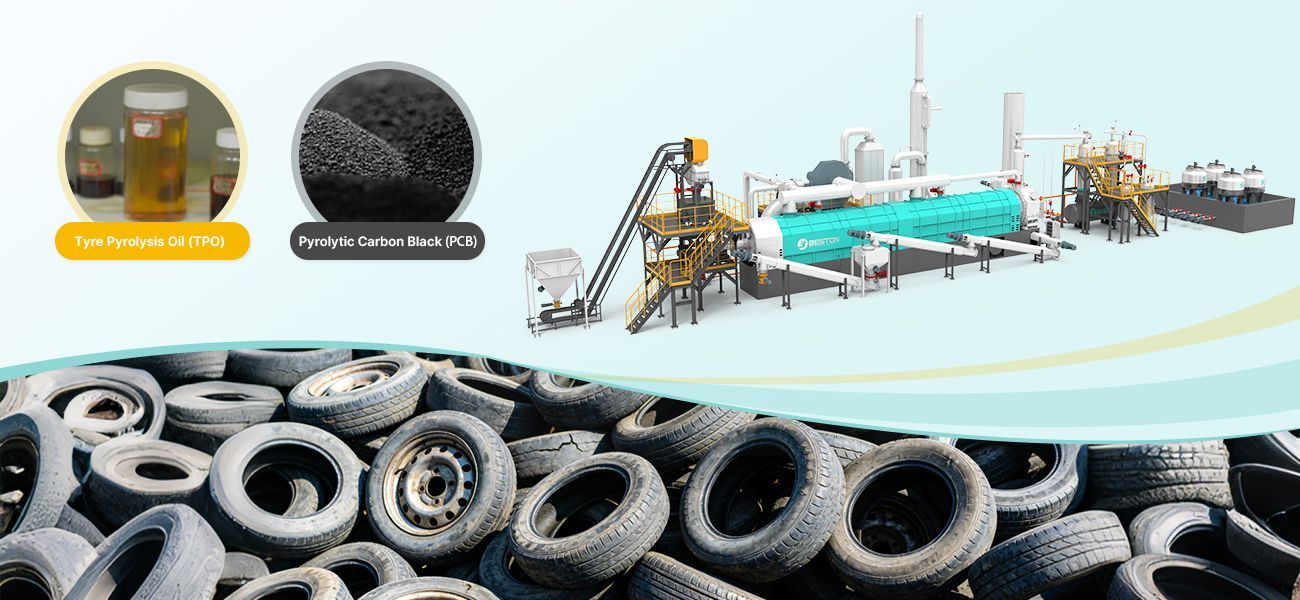
End-of-life tyres present a formidable municipal and industrial waste challenge due to their cross-linked vulcanized rubber matrices and resistance to natural biodegradation. Stockpiling these elastomeric wastes creates persistent fire hazards and vector-breeding habitats. Conventional disposal methods like landfilling or direct incineration fail to capture the high-value hydrocarbons embedded within synthetic and natural rubber compounds. Implementing an industrial pyrolysis plant for end-of-life tyres provides a thermochemical conversion pathway that depolymerizes scrap rubber into valuable chemical fractions, liquid fuels, and solid carbonaceous residues. Thermochemical Mechanisms of Tyre Rubber Depolymerization Tyre rubber is a complex composite consisting of polyisoprene, polybutadiene, styrene-butadiene rubber, carbon black, steel cord, and inorganic additives. Converting this complex matrix requires precise thermal cracking within an oxygen-deprived environment. A specialized waste tire pyrolysis equipment operates by breaking the strong covalent carbon-carbon and carbon-sulfur bonds that constitute the vulcanized rubber lattice. When scrap tyres are heated to temperatures between 400°C and 600°C, the organic polymer chains undergo scission without combustion. Thermal degradation initiates with the cleavage of weak polysulfidic cross-links before progressing to the random scission of the main hydrocarbon backbone. This devolatilization phase generates a complex mixture of condensable hydrocarbon vapors, non-condensable permanent gases, and a non-volatile solid fraction consisting of carbon black and inorganic fillers. Core Operational Stages of Industrial Pyrolysis Systems The transformation of whole or shredded tires into refined outputs relies on a series of integrated mechanical and thermal operations designed for safety and material stability: Feedstock Pre-Treatment: Whole tyres undergo mechanical de-beading to extract high-tensile steel wire bundles prior to shredding. The remaining rubber is processed into uniform shreds to optimize thermal conductivity and ensure steady movement through the reactor feed system. Anoxic Pyrolysis Reactor: The prepared rubber granules are fed into a sealed continuous rotary kiln. Maintaining strict hermetic sealing prevents oxygen ingress, eliminating combustion risks while ensuring the purity of the synthetic vapors generated during thermal cracking. Vapor Condensation and Fractionation: Heavy vapor fractions exit the reactor chamber and enter a multi-stage condensing system. Rapid cooling fractionates condensable hydrocarbons into liquid pyrolytic oil while separating non-condensable light gases for thermal energy recovery. Char Cooling and Magnetic Separation: The hot solid carbon residue exits through a water-jacketed cooling screw to drop the material below auto-ignition temperatures. Inline high-intensity magnetic separators recover fine steel wires before the char undergoes micro-milling. Recovery Profiles and Commercial Output Properties Thermochemical depolymerization yields four distinct, high-value resource streams that integrate directly into industrial manufacturing and energy supply chains: Pyrolytic Oil (Heavy Hydrocarbon Liquid) The primary liquid product is a dark, complex mixture of aromatic, aliphatic, and naphthenic hydrocarbons with a high gross calorific value exceeding 40 MJ/kg. Pyrolytic oil serves as a direct substitute for heavy fuel oil in industrial boilers, furnaces, and power generation systems. Advanced hydro-treating and fractional distillation can further upgrade this liquid into commercial-grade diesel substitutes or chemical feedstocks such as limonene and toluene. Recovered Carbon Black (rCB) The solid char residue remaining after devolatilization contains recovered carbon black alongside zinc sulfide and inorganic fillers. Raw pyrolytic char undergoes pulverization, de-ashing, and pelletization to produce commercial-grade rCB. This material replaces virgin carbon black derived from fossil fuels in semi-reinforcing rubber compounds, masterbatches, coatings, and printing inks, drastically reducing industrial carbon footprints. Non-Condensable Syngas Loop The non-condensable gas fraction consists predominantly of methane, ethane, propane, hydrogen, and hydrogen sulfide. Instead of venting or flaring these gases, the plant routes them through gas scrubbing units to remove sulfur compounds before directing the purified syngas back into the furnace burners. This closed-loop thermal integration makes the continuous operational cycle self-sustaining, minimizing reliance on external fuel sources. High-Tensile Steel Wire Recovery Steel wire extracted during pre-treatment and post-pyrolysis magnetic separation retains high tensile strength and structural integrity. Recovered steel is directed to scrap metal recyclers and electric arc furnace steelmakers for remelting, establishing a complete circular economy for tyre reinforcement materials. By integrating continuous thermochemical processing, modern processing units divert millions of scrap tyres from landfills while yielding essential raw materials for energy and manufacturing sectors.