How Catalytic Pyrolysis Solves the Wax Problem in Plastic Pyrolysis Oil
Plastic pyrolysis is an effective way to convert waste plastics into liquid oil, combustible gas, and solid residues. However, one common challenge in plastic pyrolysis is the formation of wax in the pyrolysis oil. High wax content can increase oil viscosity, cause blockages in pipelines, and complicate storage, transportation, and downstream refining.
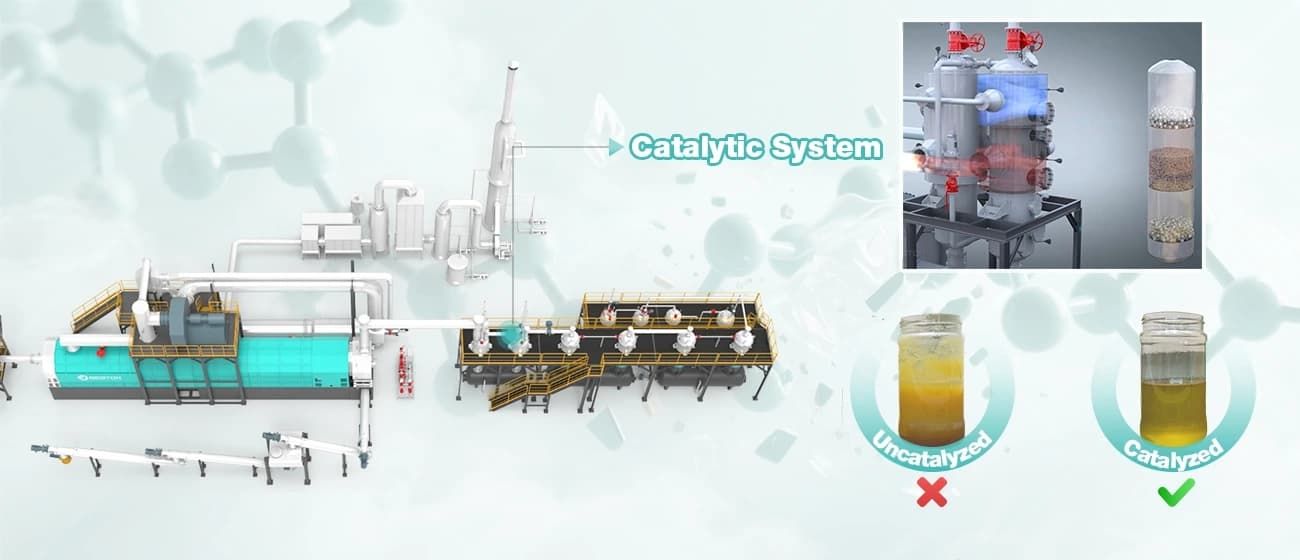
Catalytic pyrolysis offers a potential solution by promoting the breakdown of heavy hydrocarbon molecules into lighter compounds. By selecting suitable catalysts and optimizing operating conditions, plastic pyrolysis projects can improve oil fluidity and product quality. But how does catalytic pyrolysis work, and can it completely eliminate wax formation?
1. Why Does Plastic Pyrolysis Oil Contain Wax?
Plastic pyrolysis involves heating plastics in an oxygen-free environment to break long polymer chains into smaller hydrocarbon molecules. The resulting products depend on the plastic type, reaction temperature, residence time, and reactor configuration.
Polyethylene (PE) and polypropylene (PP) are particularly prone to producing waxy products because their molecular structures contain long hydrocarbon chains. When these polymers decompose, some of the resulting hydrocarbons remain relatively heavy and may condense into wax at lower temperatures.
Several factors can contribute to wax formation:
- Low or insufficient reaction temperature: Some heavy hydrocarbons may not undergo sufficient cracking, leaving high-molecular-weight compounds in the product stream.
- Short vapor residence time: Heavy hydrocarbon vapors may leave the reactor before undergoing further thermal decomposition.
- Feedstock composition: PE and PP can produce substantial amounts of long-chain hydrocarbons under certain operating conditions.
- Cooling and condensation: Heavy hydrocarbons may condense or solidify as the vapor stream cools, causing wax accumulation in collection equipment and pipelines.
Wax is not necessarily a contaminant introduced from outside the process. It is often a natural product of plastic decomposition. The challenge is controlling its formation and distribution to obtain oil with the properties required by the intended application.
2. How Does Catalytic Pyrolysis Reduce Wax Formation?
Catalytic pyrolysis introduces a catalyst into the pyrolysis process to accelerate the breakdown of hydrocarbon molecules and influence product distribution.
Unlike conventional thermal pyrolysis, which relies primarily on heat, catalytic pyrolysis uses active catalyst sites to facilitate additional cracking and other chemical reactions. This can help convert heavy hydrocarbons into lighter liquid hydrocarbons and non-condensable gases.
Promoting the Cracking of Heavy Hydrocarbons
Catalysts such as suitable zeolites, silica-alumina materials, and other catalytic formulations can promote the cracking of long-chain hydrocarbons into smaller molecules.
For example, heavy hydrocarbon vapors generated from PE or PP may undergo further cracking before condensation. Under appropriate conditions, this can reduce the amount of heavy wax-forming compounds entering the oil collection system.
Improving Hydrocarbon Product Distribution
Catalysts can also change the relative proportions of different hydrocarbon fractions. Depending on the catalyst and process conditions, catalytic plastic pyrolysis machine may increase the production of lighter hydrocarbons, including gasoline-range compounds, while reducing heavy liquid fractions.
However, stronger cracking does not always mean higher liquid oil yield. Some hydrocarbons may be converted into permanent gases, so the optimal catalyst depends on whether the project prioritizes liquid yield, oil fluidity, or a specific product composition.
Reducing Wax-Related Operational Problems
When catalytic cracking reduces the concentration of heavy hydrocarbons, the resulting oil may exhibit lower viscosity and improved flow characteristics. This can help reduce wax accumulation in downstream equipment.
Nevertheless, the actual improvement depends on the feedstock, catalyst activity, reactor design, and temperature profile. Catalytic pyrolysis should therefore be evaluated through feedstock-specific testing rather than assumed to eliminate wax entirely.
3. Key Factors for Optimizing Catalytic Plastic Pyrolysis
Adding a catalyst alone does not guarantee wax-free oil. Several process variables must be considered together.
- Catalyst selection: Different catalysts have different pore structures, acidity, cracking activity, and selectivity. Zeolite-based catalysts, for example, can promote the formation of lighter hydrocarbons, but excessive cracking may reduce liquid yield and increase gas production.
- Reaction temperature: Temperature influences both thermal and catalytic cracking. The appropriate range depends on the plastic feedstock, catalyst, and target products. Excessive temperatures can increase energy consumption and unwanted gas formation.
- Catalyst-to-feed ratio: The amount of catalyst affects contact between hydrocarbon vapors and active sites. An insufficient quantity may limit cracking, while excessive catalyst use can increase costs and complicate solids handling.
- Vapor residence time: Adequate contact time allows heavy hydrocarbons to undergo further cracking. However, overly severe cracking can shift valuable liquid products toward lighter gases.
- Condensation system design: Even when catalytic cracking reduces wax production, heavy compounds may remain. Proper temperature control, staged condensation, and appropriate pipeline heating can help prevent wax from solidifying in downstream equipment.
5. Is Catalytic Pyrolysis Oil Completely Wax-Free?
Not necessarily. Catalytic pyrolysis can reduce wax formation, but the result depends on the catalyst, feedstock, and operating conditions. Some heavy hydrocarbons may remain in the oil, and wax may still form during cooling or storage.
For projects requiring low-wax or wax-free oil, consider combining catalytic cracking with optimized condensation, filtration where appropriate, and downstream upgrading when necessary. Product testing should include viscosity, distillation characteristics, and relevant compositional analysis to determine whether the oil meets the intended application requirements.
It is also important to distinguish between reducing wax formation inside the reactor and preventing wax deposition after the oil has been produced. These are related but different engineering challenges.
Conclusion
Wax formation is a common challenge in plastic pyrolysis, particularly when processing polyethylene- and polypropylene-rich feedstocks. Catalytic pyrolysis can help address this issue by promoting the cracking of heavy hydrocarbons into lighter compounds, potentially improving oil fluidity and reducing downstream wax accumulation.
However, achieving the desired oil quality requires more than catalyst addition. Catalyst selection, reaction temperature, vapor residence time, and condensation system design must work together to balance wax reduction, liquid yield, and operating costs.
For plastic recycling projects, a well-designed catalytic pyrolysis system can provide greater control over hydrocarbon product distribution. The most suitable solution should be determined through feedstock analysis, pilot testing, and evaluation of the final oil's intended use.