Shutdown and Restart Time of Pyrolysis Reactors: Why Continuous Pyrolysis Technology Is the Future
In industrial pyrolysis projects, many investors focus on reactor capacity, oil yield, and equipment price. However, one critical factor is often overlooked: shutdown and restart time.
For a pyrolysis reactor, stopping production is not simply turning off the heating system. The reactor must complete material discharge, reduce internal temperature safely, handle residual gases, and go through a controlled reheating process before production can resume. These hidden time losses can significantly affect annual production capacity and profitability.
This is one of the key reasons why continuous pyrolysis technology is becoming increasingly important for large-scale waste recycling projects.
1. Why Does a Pyrolysis Reactor Need Cooling Before Shutdown?
A pyrolysis reactor operates under high-temperature and oxygen-free conditions. During operation, the reactor contains hot carbon materials, pyrolysis vapors, and combustible gases.
When a traditional batch reactor stops, operators usually need to:
- Stop feeding raw materials
- Complete the pyrolysis cycle
- Discharge finished products
- Remove remaining gases
- Lower reactor temperature gradually
- Check equipment conditions before restarting
The cooling process is necessary because sudden temperature changes can create thermal stress on the reactor shell and internal components.
For large reactors, the cooling stage can take many hours. During this period, the equipment occupies space but generates no economic output.
2. Restarting a Batch Pyrolysis System Requires Additional Time
Restarting a cold pyrolysis reactor is also a time-consuming process.
Before new production begins, operators must:
- Inspect the reactor and supporting equipment
- Start the heating system
- Wait until the reactor reaches the required operating temperature
- Adjust temperature distribution
- Begin feeding raw materials gradually
Depending on reactor size and heating method, reaching stable operating conditions may require several hours.
This means that frequent shutdown and restart cycles reduce the actual working time of the equipment.
For example, a machine designed for 24-hour operation may lose significant production hours if it needs frequent cooling and reheating between batches.
3. Hidden Costs Behind Frequent Shutdowns
The time loss caused by shutdowns affects more than production volume.
- Energy Waste: Heating a cold reactor requires a large amount of energy. Every restart means repeating the heating process, increasing fuel or electricity consumption.
- Lower Equipment Utilization: Even if a batch reactor has a high processing capacity per cycle, frequent idle periods reduce the annual utilization rate.
- Increased Labor Requirements: Manual operations such as feeding, discharging, temperature adjustment, and restart preparation require more workers and management time.
- More Thermal Stress: Repeated heating and cooling cycles accelerate material expansion and contraction, which may increase maintenance requirements over long-term operation.
4. How Continuous Pyrolysis Technology Solves the Problem
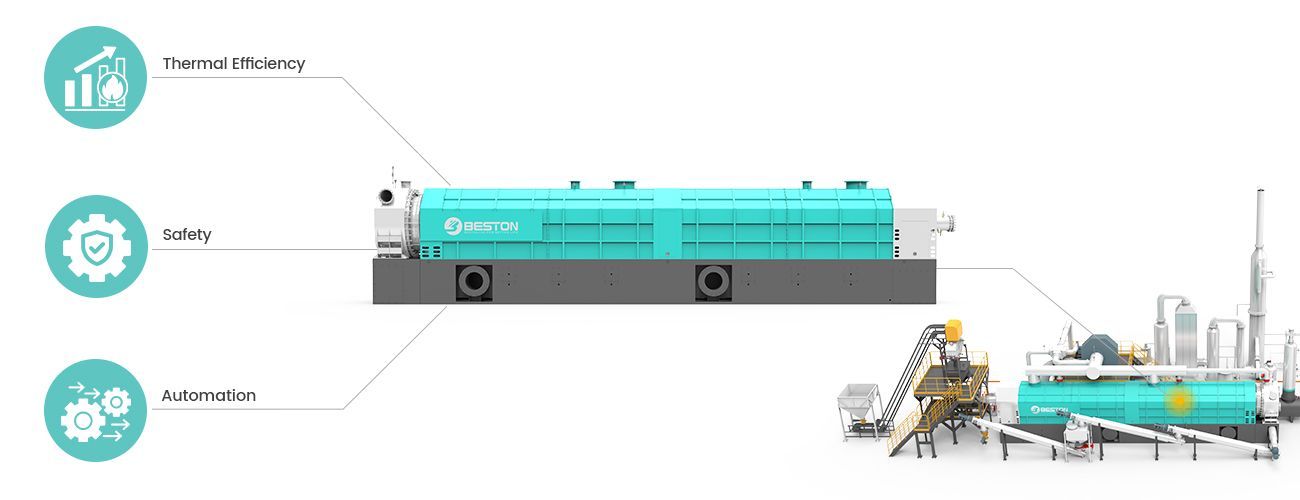
Continuous pyrolysis systems are designed to maintain stable operation for extended periods.
Unlike batch equipment, continuous systems typically use:
- Continuous feeding mechanisms
- Automatic material discharge systems
- Stable temperature control
- Integrated gas recycling systems
- PLC-based operation monitoring
The reactor remains at the optimal working temperature instead of repeatedly cooling down and heating up.
This design significantly reduces downtime and improves production efficiency.
5. Continuous Operation Improves Long-Term Project Economics
For commercial recycling facilities processing large amounts of waste plastic, tires, biomass, or oil sludge, production stability is often more important than the initial equipment investment.
A continuous pyrolysis system can provide advantages such as:
- Higher annual operating hours
- More stable product quality
- Lower labor dependence
- Reduced energy loss
- Easier industrial-scale management
Although the initial investment may be higher, the improved utilization rate can create better long-term returns.
6. Why Continuous Pyrolysis Is Becoming the Future Trend
As recycling industries move from small experimental projects toward industrial-scale production, equipment efficiency is becoming a key competitive factor.
The future of pyrolysis is not only about increasing reactor size but also about maximizing operational time. Reducing unnecessary shutdown and restart periods allows companies to process more waste, recover more valuable products, and achieve better economic performance.
Conclusion
The shutdown and restart process of a traditional pyrolysis reactor can create significant hidden losses in time, energy, and labor. For small projects, this may be acceptable, but for commercial recycling operations, these limitations become increasingly obvious.
Continuous pyrolysis technology solves this challenge by maintaining stable temperature conditions and enabling long-term automatic operation. As the demand for efficient waste conversion continues to grow, continuous systems are becoming a more practical choice for the future of industrial pyrolysis.